A Few Numbers by my Walt Whitman High School / Alumni Band.
The band in the band room.
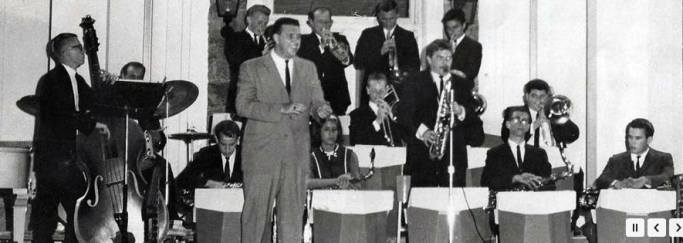
Jacob Jones, featuring John Gatchell on trumpet (center, back row), John Dellera on tenor sax (left), and showcasing each section: saxes, trombones, trumpets, and rhythm.
The band playing at Heckschire Park, Huntington (I’m hidden behind Clem DeRosa).
On It, featuring John Dellera on tenor sax (to leader Clem DeRosa’s right), Mike Hughes on piano (far left in the first picture, off camera to the left in the second), and Alan Gauvin on alto sax (standing center) – as well as Eddie Balsamo on drums (2nd picture), and Ron Smith on bass (2nd picture).
The only time I ever “practiced” trombone in those days was during rehearsals led by our leader Clem DeRosa, aka Mr. D. But what the heck, here’s a recording from Jr. High days, featuring first John DeFato on trumpet, and then me on trombone in Moonlight In Vermont.
About some of the guys who went on to pro careers:
Alan Gauvin: saxophonist (mostly lead alto) with Lee Castle, Woody Herman, Buddy Rich, Gerry Mulligan, Buddy Morrow, and Ray Charles.
John Gatchell: prolific trumpet player in New York City recording studios, became one of the founding members of the horn band Ten Wheel Drive, then Gotham, and was among the musicians hand-selected by Paul Simon, who chose whom he considered to be the finest studio musicians for the 1981 Simon & Garfunkel Concert in Central Park (John shines on “Late In The Evening”).
Joe Randazzo: bass trombone (right side of trombone section in pictures above). He played with Ray Charles, Stan Kenton, Astrid Gilberto, The National Jazz Ensemble, Bill Watrous, Chico Hamilton, Frank Sinatra, The Beach Boys, George Benson, Betty Carter, Ella Fitzgerald, and many others. Broadway show orchestras as well.
Mike Hughes: Piano. Transferred after one year at MIT, where he was on the Dean’s list, to the Berklee College of Music, where he received his Bachelor of Composition Degree. He taught there several years as well. He was musical director for “Hair” in Boston and has backed up many artists including Thelma Houston and Kenny Rankin. As a writer, Mike has composed a rock opera (Rock Carmen) that was performed at the Roundhouse Theater in London, England, written and arranged music for the Buddy Rich Band, and written and performed music for the television shows “The Untouchables”, “Wings”, “Cheers” and “Dear John.”
Larry Schneider: saxophone ( 2nd from right, front row in the second picture). Has played with Billy Cobham, the Thad Jones-Mel Lewis Orchestra, Horace Silver, Jim McNeely, Mike Richmond, and Bill Evans in New York City. After moving to San Francisco, he worked with Hein van de Geyn and John Abercrombie. In Europe he has played with François Jeanneau, the Orchestre National de Jazz, Marc Ducret, François Méchali, Alain Soler, André Jaume, Éric Barret and others.
Ron Smith: bass. Played with Gary Burton, Elvin Jones, Marian McPartland, Jimmy McPartland, Dorothy Donegan, Rose Murphy, Mary Tocci, Jimmy Dorsey, and Buddy Rich.
Note: John Dellera, tenor saxophone, heard in the samples above, became a lawyer.
(Note: all are live recordings of community theater productions.)
From my first musical, Best Laid Plans, Warren and Steve convince their friend Bill to come with them to dinner at the home of Van Dyke Winery owner Henry Van Dyke, father of Warren’s girlfriend Pamela, in the song: “Saturday Night” .
In the following dinner scene from Best Laid Plans, Warren's friend Steve, interested in Pamela's sister Laura (he knows she's a recent runaway bride, but doesn't yet know why: her straight but secretly transvestite fiancee showed up at the wedding in a dress), attempts to impress Mrs. Van Dyke by telling her he just loves her dress. This sets off the sensitized Henry Van Dyke, then Mrs. Van Dyke, then Laura in, "He Said It". The scene ends when the cook inadvertently causes the butler a great deal of pain, which he handles with a stiff upper lip.
In the ensemble song "Serving Beer" from my second musical The Campaign, we see tabloid reporter Rebecca Tongue-Smith, accompanied by the Tabloid Girls: Tanya, Becky, and Cassandra, reporting on a Mason campaign event. Present are candidate Richard Mason, his fiancee Cathy, his sister Annabel, and Annabel’s amorous, cat-toting French butler Francois. Mid-way through, Robert Clairmont arrives to make a surprise announcement of his candidacy. His team: campaign manager and shoe salesman Sonny Babcock, ex-Navy friends of Bob’s: hypochondriac Fred, animal-phobic Book, Book’s wife Sophie, and the playful ghost of another Navy friend lost overboard at sea Pig.
In this scene we see Robert and Cathy wanting to reconnect, but afraid, in "I Don’t Know What To Do."
After speaking with campaign manager Sonny Babcock, Cathy believes now that despite all that has happened Robert does love her, and shows her happiness in "He Loves Me".
From The Accidental President (book and lyrics by Allan Provost, music by me John Dusenberry), a scene on a hot summer evening with President Millard Fillmore, his wife Abigail, and their children Powers and Mary singing about the current times in: "The Age of Invention."
In this scene we see Millard Fillmore not heeding Abigail's warning that he will lose re-election if he signs the Fugitive Slave Act.
After losing re-election, Millard and Abigail find themselves happy and content to have reached "Love’s Golden Age".
Millard, after Abigail has died, singing "How Lonesome This World Is".


 Music by John Dusenberry